
Focus on Meaning Over Money: A Conversation with Ms. JD’s Founder
Elizabeth Pederson
July 2, 2026
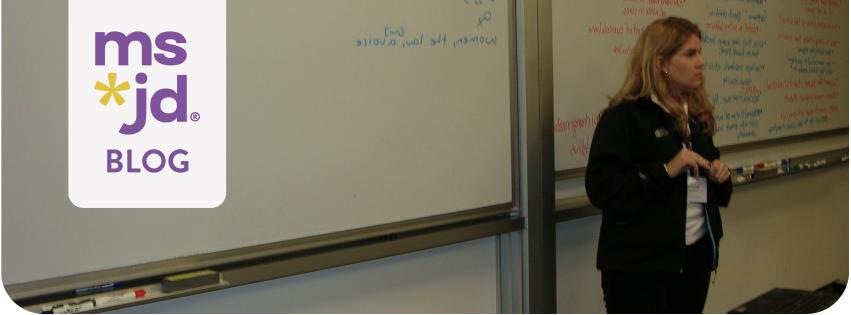
It’s been two decades since Elizabeth Pederson, then a 2L at Stanford Law School, founded Ms. JD as a blog dedicated to advancing the interests of women law students. Much has changed since then, and women now make up a clear majority of law students and associates. But the concerns Pederson had about why women weren’t finding their way into top leadership positions in the profession in the same numbers as men remain. So, of course, does the importance of community and connection for all aspiring lawyers, and especially those who come from underrepresented groups. Her assertion that “women lawyers and their allies needed to support women to continue to break through the remaining glass ceilings” feels especially timeless.
To mark Ms. JD’s 20th anniversary, we spoke with Pederson, who went on to become a social impact General Counsel, prosecutor for state and international entities, and nonprofit founder, about her memories of the organization's first days, the needs it was designed to address, and her three pieces of advice for those who come behind her.
Ms. JD: When did you enter law school and what was your experience in law school like before you founded Ms. JD?
EP: I started law school in 2004. There were a few incidents during my 1L year that still stand out: male students circulated a list of most attractive female students in the law school, and a fellow female student was ridiculed behind her back for talking in class (that she should close her mouth and instead focus on losing weight). While the majority of students were not participating in these behaviors, it was still a shock. When talking to other women at SLS about these and other incidents, the question was: “Is it just us? Are other law schools also dealing with these sorts of behaviors?” There was no way to know because at that time, there was no organization that connected women across law schools. In talking to the SLS administration about the need for such a group, they were very supportive and agreed to host a founding conference at Stanford in March 2006 with representatives from Stanford, Yale, Harvard, NYU, the University of Chicago, the University of Michigan, the University of Virginia, Cornell, UCLA, Berkeley, Georgetown, and UT Austin. Over a weekend of discussion and connection, the attendees brainstormed the seeds of a mission statement and blog for the organization that would become Ms. JD. Shortly after, elections were held for the first directors of the organization. I was honored to be elected the President of the Board, a post I served in from 2006-2012.
Ms. JD: Do you remember any particular challenges facing you or other women?
EP: The numbers were depressing: 1 woman on the Supreme Court, 17% of partners at major law firms were women, less than 25% of tenured law professors were women, only 9 state governors were women, more than 60% of states had never elected a female governor, only 1 woman had served as U.S. Attorney General, only 2 women had served as Secretaries of State, and there had never been a female solicitor general.
Ms. JD: What did you feel was missing?
EP: In some ways, the proof is in the pudding: if women do not find their way into top positions of leadership, then the question begs to be asked: why not? I never felt that the answer was a simple one but rather that women lawyers and their allies needed to support women to continue to break through the remaining glass ceilings. Even today, they still exist, which would have shocked my 2L law student self back in 2006!
Ms. JD: Was there a specific experience or insight that inspired you to start the blog?
EP: Once it was clear that a network for women law students and lawyers to connect did not exist, it was obvious that it should. There were many women behind the launch of Ms. JD–the impetus was to create a space where women law students and young lawyers could connect and support each other.
Ms. JD: Tell the story of the conversation in which you decided to launch this project.
EP: I was chatting with friends about some of the observations we had made about how women were commodified or silenced by some (a small but influential minority of) fellow law students. At that time, blogs were still a popular way to connect and share information, and since, as noted above, there was no formal organization to connect women across law schools or while starting out in the legal profession, I put forward the idea that we should start something. The Stanford Law School administration was fantastic and helped with funding and space to host the founding conference, which was also supported by many others at Stanford Law School, both students and professors.
After the founding conference, we immediately formed a 501(c)(3). While Ms. JD was a blog, it was also an organization dedicated to advancing law students and women in the legal profession, from its earliest days. The next conference that we held was to launch NWLSO (National Women Law Students Organization) in New York City. In the early days, we also funded scholarships for women studying law at Makerere University in Uganda as well as fellowships to connect law students with more experienced mentors in the legal profession.
Ms. JD: How did your leadership of Ms. JD change your law school experience or change the trajectory of your legal career?
EP: Ms. JD was always collaborative and non-hierarchical. I am still humbled by the experience of serving as the founding chair and president of the Board of Directors, but it was always a joint effort. I formed lasting friendships with the other Board members, many of whom are still dear friends.
Ms. JD: What were the most urgent needs of women law students and early career attorneys when Ms. JD was founded? What are they now?
EP: In my opinion, the most urgent needs when we started Ms. JD were connection (“where are my people?”), networking (“how can I learn from you?”), and community (“how can we support each other?”). I can’t speak to what they are now, though I suspect they might be much the same.
Ms. JD: What advice do you give to women law students?
EP: Twenty years later, my career has taken me across the world and through multiple jobs, but I wouldn’t trade it for the world. The three pieces of advice that have served me well are: follow your passions, aim to make the world better, and focus on meaning over money.